
Newsletter March 2026
Welcome
v. Port Director Mogens Pedersen
Hereby comes the 4th edition of our newsletter. We hope that you will enjoy reading the newsletter. With the newsletter, we would like to inform you about some of the topics we are currently spending time on here at Hvide Sande Harbor.
It has been a somewhat peculiar winter with a lot of easterly winds and ice formations in the fjord, but now spring is lurking around the corner. We probably need that. It brings more life to the town and also gives more life to the harbor.
Hvide Sande Harbor has achieved a record turnover of almost 48 million DKK in 2025 and a profit of more than 7 million DKK. This gives the harbor the opportunity to continue developing, and right now there is good progress in the construction of a new quay over by the West Harbor, just as the back areas there are being improved. Finally, we have also applied for dredging to 8 meters so that we can handle more tasks here in Hvide Sande.
Happy reading. If you wish to subscribe or unsubscribe as an automatic receiver of this newsletter, you can contact the undersigned at mp@hvshavn.dk.
What is happening at the Harbor
The relocation of the storage houses on Beddingsvej has been completed, and all houses are now placed in the area close to the sluice. Hvide Sande Shipyard is working on developing the parking area in the area where the houses were previously located.
As part of Hvide Sande Harbor's strategic objectives, we are continually working on better waste sorting. As much waste as possible must be reused/recycled, and the amounts of flammable waste and, not least, landfill waste must be minimized. In the near future, we will set up new waste bins at the quays intended for ship waste. With the other initiatives we have undertaken in all other areas at the quays, we expect better sorting of the different waste amounts, which will contribute to lower CO2 emissions.
Dredging of the marina has been completed in cooperation with the shipyard, and the season is now secured for the boating community on the fjord side. It is also expected that the fairway from Tyskerhaven will be cleaned up and prepared for the season.
New washing areas have been established at the motorhome parking spaces. Furthermore, we are in the process of setting up new payment systems at the motorhome parking spaces, which will allow for card payments instead of cash, which has been in high demand.
It has become increasingly difficult for Hvide Sande Harbor to use pesticides for weed control, which is why we have now acquired an environmentally friendly version for weed management. The solution consists of a hot water vapor system that combats weeds without chemicals.
New outdoor lighting has been installed on the exterior side of the fish auction towards the harbor basin, providing new and contemporary lighting to benefit those who walk around the quay areas.
As most of you may have noticed, there are again film shoots happening at Hvide Sande Harbor. It is Nordisk Film making a film about Cheminova, and they have found the surroundings in Hvide Sande attractive. The film is set to be released in 2027.
In cooperation with stakeholders for Skjern Å and the salmon population, we have obtained the Nature Agency's permission to regulate the cormorant at the outlet of Ringkøbing Fjord/Skjern Å. Regulation is done to protect the migrating smolt (smolt is a young salmon or trout in the phase where it leaves the waterways and migrates out to sea). The permit is valid from 23.03-31.05 2026. The regulation itself is carried out by hunters according to the hunting and wildlife management laws from specified locations in the harbor areas.
No bidders for the area at Sluseøen
As previously mentioned, we had a bidding deadline on January 16, 2026, for potential investors for the area at Sluseøen. Unfortunately, there were no bidders. Based on feedback from consultants and others, there has probably been a particular concern regarding the lengthy administrative processes that are part of such a project, as well as some also feeling that Hvide Sande Harbor has been a bit too risk-averse. The harbor is now in a brainstorming phase regarding how we can move forward. Perhaps we as a harbor should work to resolve some of the administrative challenges, and we are also looking into whether interest can be generated by taking more responsibility for some of the environmental and economic risks associated with the project.
Finally, one might believe that the project will be strengthened by the municipality's efforts to establish a swing bridge and City Square. These are municipal projects that have received significant support from, in particular, the Business Promotion Board, but also from Realdania, Danish Coastal and Nature Tourism, and Hvide Sande Harbor. The completed project is set for establishment in 2027. Right now, efforts are particularly focused on designing a swing bridge that can both meet the practical requirements and handle changing weather conditions and water levels.
Henning's anecdotes: Caught by the drawbridge!
If you live in Hvide Sande, you know this: The road over the chamber sluice is the town's bottleneck if you're coming from the north or south – or if you just need to get to the harbor, you have to cross the bridge.
In the 90s, up to 1,600 ships passed through the sluice each year. Nowadays, traffic has decreased, but the stories... well, they have not diminished.
The drawbridge – the town's best excuse
The drawbridge has not only been for passage – for decades, it has been the students' best excuse for being late, saving many from scoldings and a trip to the inspector’s office.
When the teacher asked, “Why are you only just arriving now?”, the reply came lightning fast: “The bridge was up, and the ship took forever to get through!”
It worked so well that students from the north side also tried their luck – until the teacher discovered that they actually lived on the north side and didn’t have to cross the bridge to get to school.
The bridge and the police – a collaboration with action movie potential
The bridge has also played a somewhat... should we say more active role in local crime history.
The police and the guard have had a good collaboration over the years. Many local officers have shared a number of cups of coffee in the guard shack, and there have been several small missions where the bridge was the secret weapon.
The vacation home burglars with poor timing
One morning in the 90s, the police called the guard: “We are pursuing a wanted car that is driving south from Søndervig. Can you open the bridge?”
“Sure thing!”, the guard responded. The bridge was opened and stood there like a huge STOP sign while the locals in the queue wondered: “Why isn’t there a ship coming through the sluice...?”
In the queue from the north side, a station wagon held, and the passengers began to look increasingly nervous. Suddenly the doors flew open, and three men took off in different directions: One ran along the bridge and hid by Blåtårn. One slipped over to Otto Peders vej. One disappeared behind a slipway and hid behind a stack of wood.
The guard was able to keep an eye on the three from the car and could precisely see where each of them was hiding. When the police arrived and looked into an empty car, the guard called the police and pointed them in the right direction where they could find the three from the car. One by one, they were arrested.
The dog kidnappers who waited patiently
A few years later, the police called again: “We have a couple who have stolen a dog from a kennel that we would like to talk to. Can you open the bridge until we've spoken with them?”
The bridge was opened, and the same situation unfolded: The queue got long, and the locals wondered again about the absence of ships.
The couple in the car sat completely still and calm – as if they hadn’t figured out that there was probably a reason why the bridge suddenly stood open with not a single vessel in miles.
The police arrived, approached the car, knocked on the window, and asked very dryly: “Don't you have one dog too many in there?”
And that case was also settled.
So yes – the bridge can indeed be annoying sometimes, we all know that.
You sit there in the car, look at the clock, look at the bridge, and think: “Oh for goodness' sake... am I really going to sit here staring again?”
But the truth is that even though the bridge can be incredibly irritating, it can also be useful for a bit of everything: it saves school kids from scoldings, it helps the police, and it gives us others a good story to tell! – and then there was just when the bridge clapped down, but that story comes later.
Have you heard that: Hvide Sande Harbor is working to bring back the crane that helped to close the canal in 2015 to Hvide Sande?
Key Figures
We are underway with 2026 but still lack the final key figures to provide a complete and accurate overview of the year's initial months. This means we cannot yet present the overall picture of development at the beginning of the year – but the activity level at the harbor is already indicating a good start in 2026.
The fishing in Hvide Sande Harbor went well in 2025, particularly within industrial fish and crabs. Goods loaded over the quay fell slightly to 141,000 tons from 151,000 tons the previous year.
This positive development in fishing was due in part to favorable weather conditions as well as increasing landings of both industrial fish and crabs, along with good prices. At the same time, the goods transshipment over the quay saw a minor decrease compared to last year, where 151,000 tons were handled, while in 2025, it was 141,000 tons over the quay.
Despite this small decrease in the volume of goods, the harbor is still expected to play an important role for businesses in the area, and initiatives are already being worked on to strengthen both fishing and goods activities in the coming years.
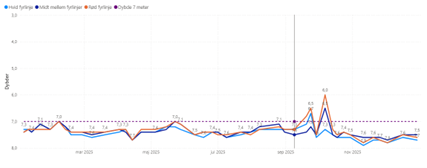
In 2025, the depth of the entrance was good, with over 7 meters in at least one buoy line all year round. The entrance is surveyed about 60 times a year, and the quality of the depths is assessed each time.
Appointment of the Board
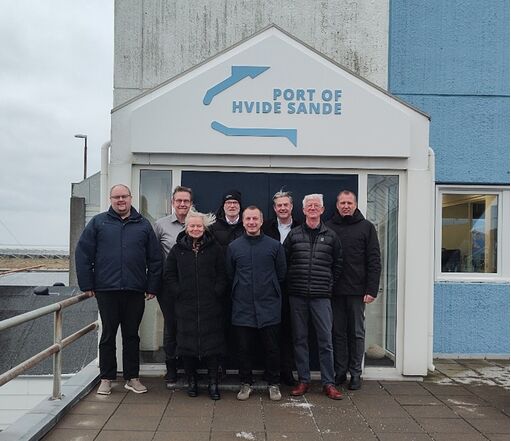
Hvide Sande Harbor has a new board. Hvide Sande Harbor is a municipal self-governing harbor. This means that the harbor is owned by the municipality, but we have considerable independence. It also means that one of the newly elected City Council's first tasks is to approve the composition of a new board. The City Council has appointed Lennart Qvist and Carsten Bjerg as the two City Council members on the board. Furthermore, they have approved the recommendation from the Southwest Jutland Fishermen's Association of Thomas Rahbek Sloth to the board. Finally, they have approved the proposal that Hans Schneider, Steen Davidsen, Richard Hvas, and Lisbeth Valther make up the remaining four board members. Subsequently, the board has constituted itself with Hans Schneider as chairman and Lennart Qvist as vice-chairman.
A has heard down by the quay: That the herring quota this year will be 6,452 tons in area 2, and 8,549 tons in area 1. Expected start mid-April.
A new Fisherman's House is approaching on the horizon
The first outlines of the future Fisherman's House are slowly taking shape on the horizon. Three prominent architectural firms have provided sketch proposals for how Hvide Sande's dramatic history can be showcased in new buildings with new exhibitions that could become a landmark for the town. The three proposals are very different, but they all focus on further developing the existing building stock.
There is a long way to go and much that needs to fall into place before the rescue boat is staged in a new large exhibition, before the story of the sluice is ready, and before a new exhibition can tell about the remarkable development of fishing from shore fishing to today. Work is underway, but initially behind the scenes.
However, there is news from the Fisherman's House in the meantime. The 2026 season will include a new exhibition about World War II on the West Coast and in Hvide Sande. A reconstructed bunker will take visitors back to the time when German soldiers nervously scanned the sea. Is the invasion coming?
Demolition of the rescue station
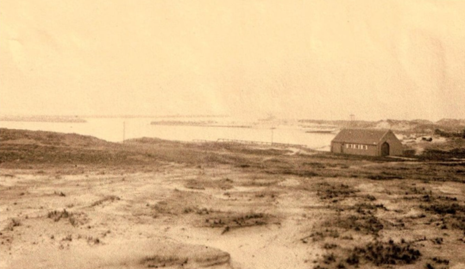
Back in 2023, Hvide Sande Harbor purchased the old rescue station on Nordhavnskaj with the intention of demolishing it. The area is to be made ready for new activities.
The rescue station is part of the earliest Hvide Sande history but has not been used as a rescue station for many years, and the building is now in serious disrepair and located in the midst of a commercial area, where there is a need for more modern buildings. Hvide Sande Harbor does not have many options for expanding the harbor, and large parts of our areas are nature-protected areas, so we must ensure that the areas that can actually be used are utilized as well as possible.
We are well aware that it would have been fortunate to be able to preserve the building, and we have considered what we can do to keep the memory of the building alive.
We have had Ringkøbing Fjord Museums photograph the building both inside and out. In addition, we will save relevant parts of the building, such as window frames, rafters, etc., so that other actors can see these things or perhaps even reuse them. We have also considered whether we should give people the opportunity to come and collect bricks from the demolition. For many years ago, small pieces of the Berlin Wall could be obtained as a memory of that wall, and in the same way, it might be interesting for some to get bricks from the Rescue Station as a reminder of it. If you have other ideas for how we can keep the memory of the rescue station from completely fading away, we would love to hear it.
ISO certification, what is it and why is it important
Hvide Sande Harbor was first certified in January 2023 under the ISO standards 9000 (quality), 14001 (environment), and 45001 (occupational health and safety). In January 2026, we were recertified for a new 3-year period.
The purpose of the certification is a management commitment to ensure a qualified and structured approach to work within the areas of the standards for the benefit of employees, customers, harbor users, and external stakeholders. The latter can include various authorities such as the Environmental Protection Agency, the Coastal Directorate, the Maritime Authority, the Traffic Authority, and Ringkøbing Municipality.
Management-wise, it means that there is ongoing reporting and evaluation of all significant parameters within the three standards and that the work with the standards ensures continuous improvement of quality, environment, and occupational health and safety.
Quay 109 – where past and future meet
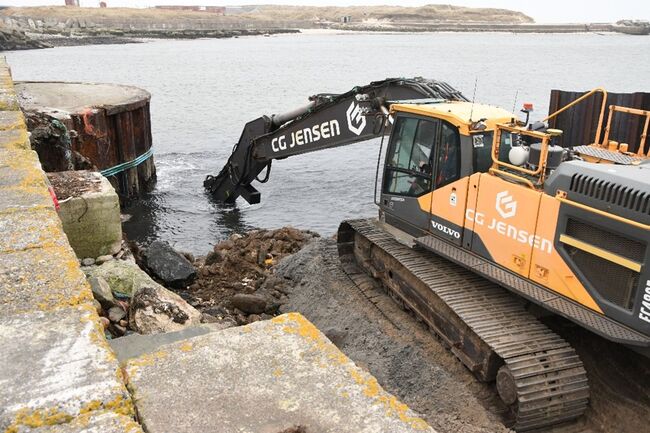
The work on the establishment of Quay 109 is well underway, and as often happens when building further on the history of the harbor, the project has also encountered significant obstacles during the work. Here, large rock blocks and old concrete dikes have appeared – remnants from the time when the canal was closed in the early 1900s.
Nordre Sikring was originally established in connection with the canal's closure in 1915, and historical accounts tell that a violent storm in 1912 washed away parts of the then existing protection. At that time, large blocks and concrete dikes were hastily thrown into the water to protect the canal and rebuild the protection. More than 100 years later, these massive materials are what we are now encountering again during the construction work.
It has been exciting to see what has been hidden in the depths when we have come across old materials and remnants from earlier times during the work. Each new discovery has given us a small insight into the harbor's history and the challenges that were handled back then.
Although encountering the old blocks has posed challenges in execution, it has not changed the direction or significance of the project. The challenges have been managed through technical adjustments and redesign in close cooperation between contractor, consultants, and the harbor. Work continues according to the revised plan, and the project is still on track for completion.
Quay 109 is an important step in the continued development of Hvide Sande Harbor. The new quay and the associated back area provide better conditions for handling bulk, project goods, and offshore activities, thereby strengthening the harbor's flexibility and capacity. At the same time, Quay 109 helps create the basis for new opportunities and activities in the harbor – to the benefit of both the business community and the local area.
When Quay 109 is completed, it will be a clear example of how the harbor’s history and future are interconnected – built on past solutions and with an eye on the next several decades of development.
Facts about quay 109 - Length: 100 meters - Depth at quay: 7 meters - Back area: 3,500 m2